Calcium Tablet products require consistent mechanical strength to ensure they remain intact during production, packaging, transport, and handling. The tablet hardness test plays a central role in pharmaceutical quality control by measuring the force required to break a tablet under controlled conditions. This breaking force reflects the structural integrity of the dosage form and helps manufacturers maintain stable product quality.
Using a tablet breaking force tester, laboratories can evaluate whether a Calcium Tablet meets predefined mechanical requirements. According to USP 1217, this test is widely used to support formulation development, process validation, and routine quality assurance in pharmaceutical manufacturing.
Tablet Hardness Test, USP 1217 and Compression Test Principles
In pharmaceutical practice, tablet hardness is more accurately described as breaking force, which refers to the force required to cause fracture of a tablet along a defined plane. In a typical compression test, the tablet is placed between two platens, and force is applied until it breaks.
Unlike friability testing, which evaluates surface abrasion, the tablet hardness test focuses on internal bonding strength. This makes it especially important for Calcium Tablet products, where both mechanical durability and proper disintegration performance must be balanced.
As described in USP 1217, breaking force data should be interpreted together with formulation and process parameters because results are influenced by tablet geometry, material properties, and manufacturing conditions.
Importance of Calcium Tablet Mechanical Strength
The mechanical strength of a Calcium Tablet directly affects its performance throughout the product lifecycle. During manufacturing, tablets undergo coating, printing, and packaging operations that introduce mechanical stress. During distribution, stacking and vibration further challenge tablet integrity.
If the breaking force is too low, tablets may:
- Chip or crack during packaging
- Break under handling stress
- Generate product loss and quality complaints
If the breaking force is too high, tablets may:
- Show delayed disintegration
- Affect dissolution performance
- Reduce bioavailability consistency
Therefore, optimizing tablet hardness is essential to ensure both durability and proper drug release behavior.
Factors Affecting Tablet Hardness Results
Several factors influence tablet hardness test outcomes:
Formulation composition: Binders, lubricants, and fillers determine particle bonding strength.
Compression force: Higher compression generally increases breaking force but may reduce porosity.
Tablet size and shape: Stress distribution changes with geometry, affecting fracture behavior.
Moisture content: Environmental humidity can alter mechanical properties over time.
Manufacturing conditions: Compression speed and dwell time also influence hardness consistency.
Understanding these variables allows manufacturers to maintain stable quality for Calcium Tablet production.
Performing a Tablet Hardness Test According to USP 1217
A standard tablet hardness test includes:
- Selecting representative Calcium Tablet samples
- Calibrating the tablet breaking force tester
- Placing each tablet between compression plates
- Applying force at a controlled speed
- Recording the maximum force at fracture
- Repeating tests for statistical reliability
- Comparing results with specification limits
Consistency in sample handling and test conditions is essential for reliable results.
Selecting a Reliable Tablet Breaking Force Tester
Accurate hardness measurement depends heavily on instrument performance. A reliable tablet breaking force tester must provide precise load control, stable speed regulation, and repeatable results.
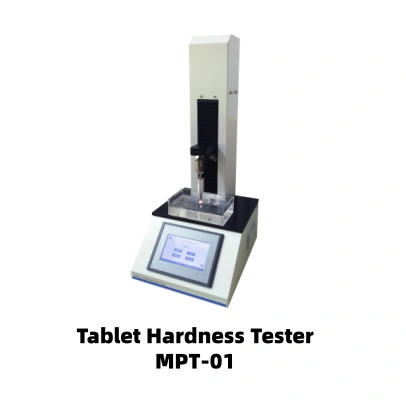
The Cell Instruments MPT-01 Tablet Hardness Tester is designed to meet these requirements in pharmaceutical quality control environments. It supports routine testing of Calcium Tablet products and provides stable force measurement for both R&D and production environments.
Its key advantages include:
- High-precision load measurement for consistent results
- Adjustable test speed for different tablet formulations
- Digital data output for documentation and traceability
- Reduced operator influence compared with manual testers
By integrating such equipment into the workflow, laboratories can ensure more reliable tablet hardness test outcomes and stronger process control during compression stages.
Relationship Between Hardness and Other Tablet Properties
Tablet hardness should always be evaluated alongside other quality attributes. In Calcium Tablet production, breaking force interacts with:
- Friability resistance
- Disintegration time
- Dissolution rate
- Tablet thickness and density
A balanced formulation ensures that tablets are strong enough for handling but still release active ingredients effectively after administration.
Conclusion
The tablet hardness test is a critical element of pharmaceutical quality control for Calcium Tablet manufacturing. Guided by USP 1217, it provides essential insight into tablet mechanical strength and process stability. When performed using a reliable tablet breaking force tester and proper compression test procedures, manufacturers can ensure consistent product quality and regulatory compliance.
Modern instruments such as the Cell Instruments MPT-01 Tablet Hardness Tester enhance accuracy, repeatability, and efficiency, making them essential tools for both routine QC and formulation development in pharmaceutical production.
 EN
EN  AR
AR  BG
BG  CS
CS  DA
DA  DE
DE  EL
EL  ES
ES  ET
ET  FI
FI  FR
FR  HU
HU  ID
ID  IT
IT  JA
JA  KO
KO  LT
LT  LV
LV  NB
NB  NL
NL  PL
PL  PT
PT  RO
RO  RU
RU  SK
SK  SL
SL  SV
SV  TR
TR  UK
UK