Introduction
Chewable tablets have become a widely used dosage form due to their convenience and patient-friendly characteristics, especially for children and elderly populations. Ensuring the mechanical integrity of these tablets is critical for maintaining quality during manufacturing, packaging, transportation, and final use. One of the key quality assessments is the Test af tablettens hårdhed, complemented by texture analysis og trykprøvning, to measure breaking force and overall tablet stability. These tests ensure that chewable tablets maintain consistent performance, regulatory compliance, and consumer satisfaction.
Chewable Tablets Tablet Hardness Test According to USP 1217
Den USP 1217 standard defines procedures to evaluate the mechanical strength of tablets, including chewable tablets. The Test af tablettens hårdhed measures the force needed to fracture a tablet by placing it between two plates, with a controlled compressive force applied until the tablet breaks. For round tablets, the load is typically applied across the diameter, a method known as diametral loading.
Breaking force, sometimes referred to as crushing strength, differs from hardness in classical material science. While hardness measures resistance to surface penetration, Tablettens hårdhed evaluates overall tablet structural integrity. Maintaining proper hardness ensures chewable tablets remain intact during handling, coating, and transport, while preserving the desired mouthfeel and palatability for the end user.
Texture Analysis and Compression Testing
Texture analysis is an essential complement to hardness testing, providing force-deformation profiles that reveal elasticity, brittleness, and resistance to compression. These insights allow pharmaceutical developers to fine-tune formulations to achieve the desired combination of mechanical strength and chewability.
Compression testing replicates stresses that tablets encounter during manufacturing, coating, packaging, and distribution. Factors such as binder concentration, excipient type, moisture content, and compression pressure can be adjusted to optimize tablet performance. Properly conducted Kompressionstest prevent tablet breakage, chipping, or deformation, which is particularly important for chewable tablets intended for direct consumption without water.
Practical Tips for Accurate Testing
To ensure reliable Test af tablettens hårdhed results, operators should follow these guidelines:
- Calibration: Regularly calibrate testing equipment to maintain accuracy.
- Sample uniformity: Use tablets from the same batch and check for size, weight, and shape consistency.
- Environmental control: Maintain stable temperature and humidity, as these factors affect tablet hardness.
- Avoid operator bias: Automated testers are preferred over manual devices to reduce variability in results.
Common Testing Challenges and Misinterpretations
During testing, some factors can lead to misleading results:
- Inconsistent placement: Incorrect positioning of tablets may cause uneven load distribution and inaccurate breaking force measurement.
- Moisture absorption: Tablets can absorb moisture from the environment, lowering their apparent hardness.
- Surface defects: Chips or cracks on tablet surfaces may reduce the recorded hardness, even if the formulation is correct.
Being aware of these potential issues helps quality control teams take corrective actions, ensuring data reliability.
Recommended Equipment: Cell Instruments Tablet Hardness Tester
For high-precision testing, the Cell Instruments Tablet Hardness Tester offers:
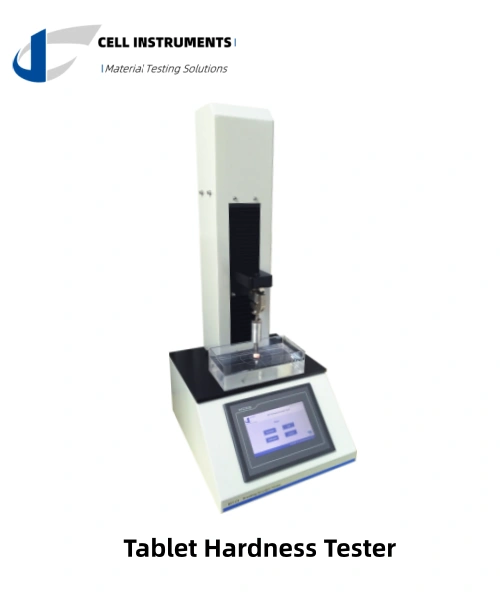
- Accurate force measurement with high sensitivity for chewable tablets.
- Automated cycles ensuring consistent and repeatable testing.
- Compatibility with round, oval, and specialty-shaped tablets.
- Compliance with USP 1217 standards, supporting global regulatory adherence.
With optional texture analysis modules, manufacturers can combine hardness and textural data to optimize formulations and monitor quality control effectively, reducing batch-to-batch variability.
Konklusion
Den Test af tablettens hårdhed is essential for evaluating the mechanical integrity of chewable tablets. Incorporating USP 1217 standards, texture analysis, og trykprøvning ensures that tablets can withstand handling, coating, and transport stresses while providing a safe and pleasant experience for consumers. Using advanced equipment like the Cell Instruments Tablet Hardness Tester enhances accuracy, repeatability, and confidence in product quality. By carefully monitoring hardness, texture, and formulation parameters, pharmaceutical manufacturers can deliver chewable tablets that are both robust and enjoyable, maintaining compliance with regulatory standards and supporting consumer trust.
 DA
DA  EN
EN  AR
AR  BG
BG  CS
CS  DE
DE  EL
EL  ES
ES  ET
ET  FI
FI  FR
FR  HU
HU  ID
ID  IT
IT  JA
JA  KO
KO  LT
LT  LV
LV  NB
NB  NL
NL  PL
PL  PT
PT  RO
RO  RU
RU  SK
SK  SL
SL  SV
SV  TR
TR  UK
UK