について vitamins tablet hardness test plays a critical role in ensuring that vitamin supplements maintain their structural integrity from manufacturing to consumer use. Vitamins tablets often experience mechanical stress during coating, packaging, transportation, and handling. If a tablet lacks sufficient mechanical strength, it may crack, chip, or break, leading to poor appearance, inaccurate dosing, and reduced consumer confidence.
For quality control professionals and formulation scientists, the vitamins tablet hardness test provides practical data that support process optimization and regulatory compliance. This test directly links tablet design, compression parameters, and final product performance, making it an essential element of pharmaceutical and nutraceutical quality systems.
USP 1217 and Tablet Compression Test Overview
USP 1217, tablet hardness test, texture analysis, and compression test concepts form the technical foundation for evaluating tablet mechanical integrity. USP 1217 defines tablet breaking force as the force required to cause fracture under controlled conditions. Although the industry often uses the term “hardness,” USP emphasizes 破壊力 as the more accurate description.
In practice, a 錠剤硬度試験 applies a compressive load to the tablet until failure occurs. This process represents a controlled 圧縮試験, while texture analysis provides a broader framework to interpret force–displacement behavior and tablet deformation. Together, these approaches allow laboratories to characterize vitamins tablets in a reproducible and standardized manner.
Why Vitamins Tablet Hardness Matters
Vitamins tablets differ from conventional pharmaceutical tablets in formulation complexity and consumer expectations. Chewable vitamins, film-coated tablets, and high-dose mineral supplements each place unique demands on tablet strength.
A properly defined vitamins tablet hardness test helps manufacturers:
- Ensure mechanical stability during coating and packaging
- Reduce friability-related defects, such as chipping or edge wear
- Maintain consistent appearance and perceived product quality
- Support downstream performance, including disintegration and dissolution
Importantly, tablet hardness should never be considered in isolation. USP 1217 highlights that hardness, friability, thickness, and porosity interact in complex ways. A balanced specification ensures tablets remain strong without compromising disintegration or bioavailability.
Principles Behind the Vitamins Tablet Hardness Test
The vitamins tablet hardness test follows a simple but precise principle. A tablet is placed between two parallel plates. One plate moves at a controlled speed, applying force across a defined plane—commonly across the diameter for round tablets. The instrument records the force at which the tablet fractures.
This method reflects the tablet’s resistance to mechanical stress rather than surface indentation. For this reason, 破壊力 serves as a reliable indicator of compact integrity. Texture analysis enhances this understanding by capturing deformation behavior before fracture, offering deeper insight into formulation and compression variables.
Practical Testing Procedure Aligned with USP 1217
A standardized vitamins tablet hardness test typically includes the following steps:
- Sample selection: Choose tablets representative of the production batch, free from visible defects.
- Instrument setup: Verify plate alignment, calibration, and test speed to ensure repeatable results.
- Tablet positioning: Place each tablet consistently to avoid uneven load application.
- Compression test execution: Apply force until fracture occurs and record the breaking force.
- Data evaluation: Analyze results for average value, variability, and compliance with internal specifications.
USP 1217 emphasizes consistency in test conditions, as loading rate and alignment directly influence results. Clear documentation supports data integrity and audit readiness.
Modern Instruments and Testing Efficiency
Early manual testers suffered from operator variability and limited precision. Modern systems employ motor-driven compression, load cells, and digital data processing. These advances improve repeatability and reduce subjective influence.
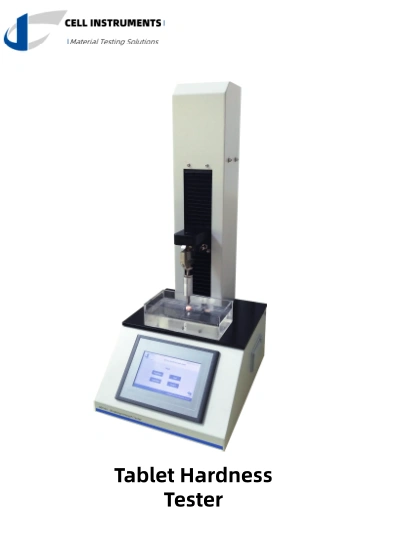
について Cell Instruments Tablet Hardness Tester provides controlled compression testing designed for vitamins tablets and other solid dosage forms. Its stable mechanical structure and precise force measurement help laboratories implement USP 1217 principles efficiently while maintaining high throughput and reliable data.
Supporting Quality Systems with the Vitamins Tablet Hardness Test
A robust vitamins tablet hardness test program strengthens overall quality assurance. It supports process validation, change control, and continuous improvement initiatives. By aligning test methods with USP 1217 and applying modern texture analysis concepts, manufacturers demonstrate technical competence and regulatory awareness.
For nutraceutical producers seeking consistent quality and professional credibility, integrating reliable tablet hardness testing equipment from Cell Instruments Co., Ltd. represents a practical step toward higher product standards and long-term market trust.
 JA
JA  EN
EN  AR
AR  BG
BG  CS
CS  DA
DA  DE
DE  EL
EL  ES
ES  ET
ET  FI
FI  FR
FR  HU
HU  ID
ID  IT
IT  KO
KO  LT
LT  LV
LV  NB
NB  NL
NL  PL
PL  PT
PT  RO
RO  RU
RU  SK
SK  SL
SL  SV
SV  TR
TR  UK
UK