
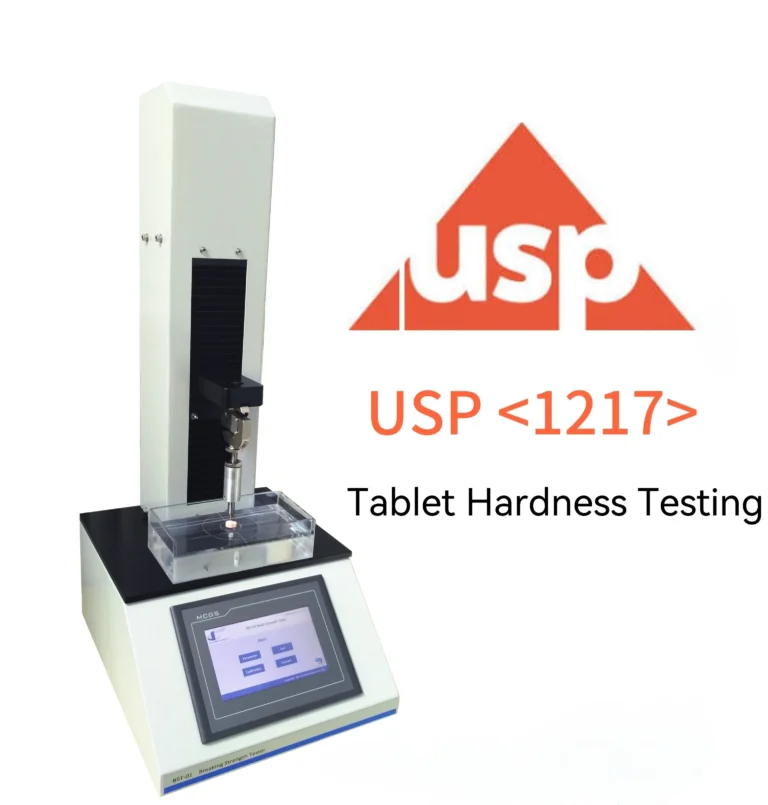
USP 1217
Tablet Hardness Testing
In pharmaceutical manufacturing, maintaining the mechanical strength of tablets is essential for product quality, patient safety, and regulatory compliance. The USP <1217> standard provides a rigorous and scientifically sound framework for evaluating tablet breaking force, more commonly referred to as dureza del comprimido.
This article outlines how USP <1217> governs the testing of tablet strength, its relationship with compression test, friabilidad, and tablet brittleness, and how modern instruments like the MPT-02 Tablet Hardness Tester from Cell Instruments ensure precise and repeatable results in quality control labs.
Tablet Hardness Test, Compression Test, and Friability: Why They Matter
Tablet integrity must be maintained from the point of manufacture to the moment of administration. During this journey, tablets encounter various mechanical stresses—vibration, compression, impact, and abrasion. Therefore, routine tablet hardness tests and compression tests are essential for:
-
Ensuring tablets do not break or chip during handling,
-
Assessing resistance to crushing under transport or load,
-
Evaluating mechanical robustness against environmental stress,
-
Meeting GMP and USP regulatory specifications.
Beyond dureza del comprimido, friability tests (USP <1216>) evaluate resistance to chipping and surface abrasion, while the tablet brittleness test and three-point bending test assess structural weaknesses, especially for specialized or scored tablets.
Tablet Breaking Force Test According to USP
USP <1217> defines breaking force as the force required to fracture a tablet in a controlled manner. This is not simply a “hardness” test in the traditional sense; instead, it quantifies the mechanical strength of the tablet matrix under controlled compressive loading.
The test setup involves:
-
Two polished, parallel platens (contact faces) that move to apply compressive force,
-
A constant loading rate (not exceeding 20 N/s or 3.5 mm/s),
-
Tablet alignment along the diameter or structural axis, ensuring reproducibility,
-
Force sensor calibrated to ±1 N accuracy,
-
Minimum 6 tablets per batch for statistical significance.
Unlike older devices (Pfizer, Strong Cobb), modern testers like MPT-02 use loadcells and real-time electronics to deliver repeatable, highly sensitive measurements, minimizing operator variability.
How to Perform a Tablet Hardness Test and Evaluate Results
During a standard ensayo de dureza de comprimidos, the tablet is positioned horizontally between two platens. A motorized system applies a progressively increasing compressive force until the tablet breaks. The peak force (in Newtons) is recorded as the tablet breaking force.
For consistent and valid results:
-
Use tablets with uniform size, mass, and shape,
-
Maintain consistent platen speed and alignment,
-
Avoid using cracked or flawed tablets unless investigating defects,
-
Calibrate the tester regularly using traceable reference weights or load cells.
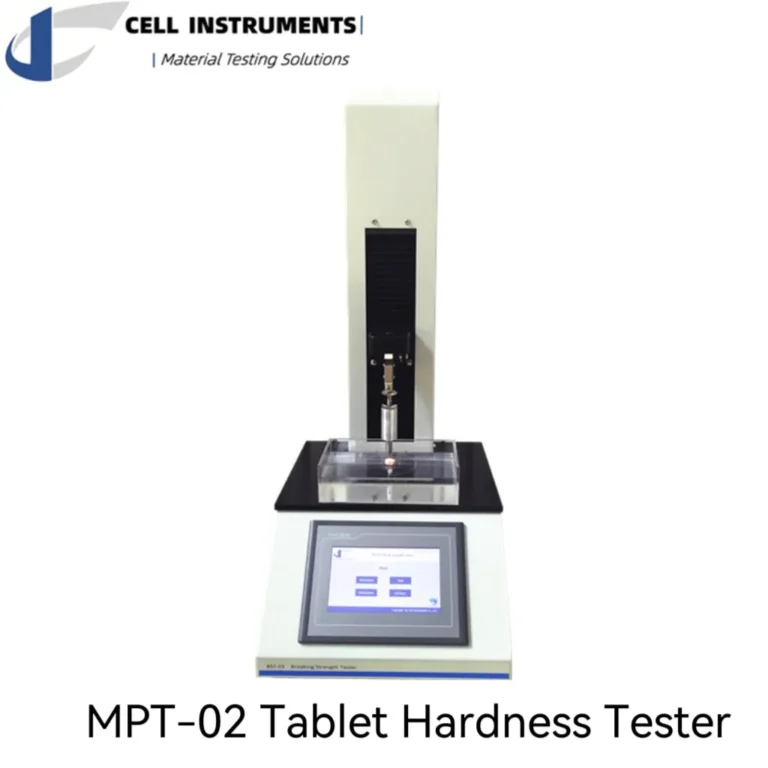
Modern equipment like the MPT-02 Tablet Hardness Tester provides real-time force display, adjustable compression speeds, and auto-return functionality for efficient batch testing.
Evaluating Tablet Brittleness and Performing a Three-Point Bending Test
Some tablets—such as capsule-shaped, chewable, or scored tablets—are better evaluated using a three-point flexure method. This test applies load at the midpoint of the unsupported tablet surface, allowing for a pure tensile failure at the opposite face. The result gives a more comprehensive indication of tablet brittleness and flexural strength, especially when conventional crushing strength tests do not yield clear outcomes.
Advantages of Using the MPT-02 Tablet Hardness Tester
The MPT-02 Tablet Hardness Tester from Cell Instruments is engineered for compliance with USP <1217>. It ensures accurate testing of dureza del comprimido, compression strength, and breaking force through:
-
A 7-inch touch screen interface for intuitive operation,
-
Adjustable loading speeds for precision across various tablet types,
-
High-precision loadcells and precision ball screw system,
-
Multi-fixture compatibility for bending, crush, and tensile tests,
-
Built-in auto return, overload protection, and optional software integration for detailed reporting.
With this system, quality assurance teams can confidently perform all relevant USP <1217> and tablet strength tests across pharmaceutical product lines.
Best Practices for Tablet Strength Testing in Quality Control
To implement a robust ensayo de dureza de comprimidos program:
-
Align test protocols with USP <1217> and USP <1216>,
-
Standardize test conditions, orientation, and specimen shape,
-
Validate instrument performance using regular calibration,
-
Monitor trends in tablet strength, friabilidad, and brittleness over time,
-
Integrate data into batch records and quality reports for compliance tracking.
Conclusion
The USP <1217> tablet breaking force test is a critical component of modern pharmaceutical quality control. By combining it with dureza del comprimido, compression testing, and friability assessment, manufacturers ensure the reliability and safety of oral solid dosage forms.
With precise control, automated features, and USP compliance, Cell Instruments’ MPT-02 Tablet Hardness Tester offers the ideal solution for laboratories seeking dependable and efficient tablet strength testing. Whether for routine QC or advanced R&D, accurate testing drives better formulation, compliance, and patient outcomes.
 ES
ES  EN
EN  AR
AR  BG
BG  CS
CS  DA
DA  DE
DE  EL
EL  ET
ET  FI
FI  FR
FR  HU
HU  ID
ID  IT
IT  JA
JA  KO
KO  LT
LT  LV
LV  NB
NB  NL
NL  PL
PL  PT
PT  RO
RO  RU
RU  SK
SK  SL
SL  SV
SV  TR
TR  UK
UK